
Morning Muse 233 : Buddha and the King
The Buddha asked the king to drop not his gifts, but his identity and pride. True awakening begins when we let go of roles and meet life simply as a human being.
2/21/20262 min read
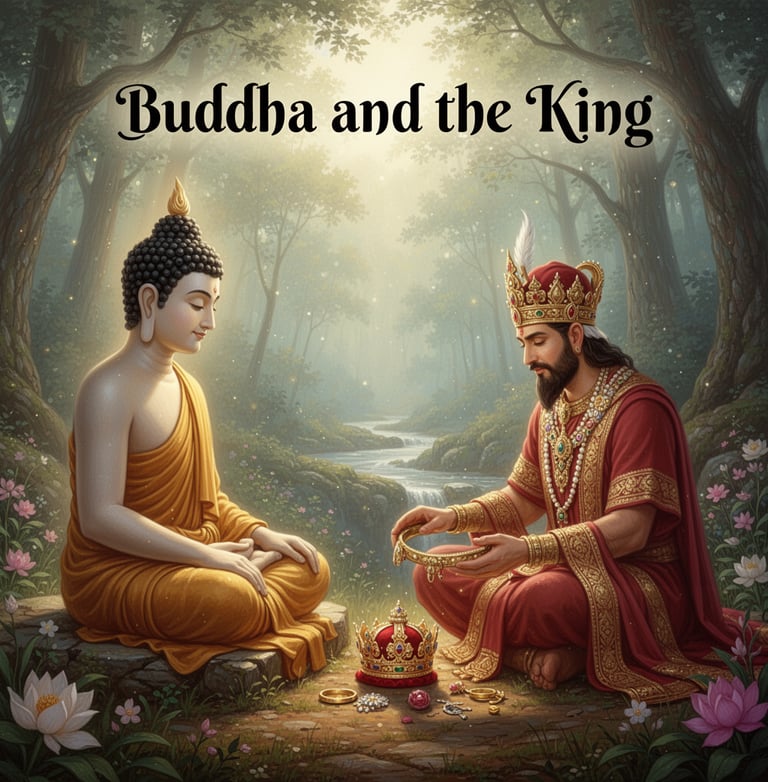
Once, a great king decided to meet Gautama Buddha for the first time. His queen had long been a devoted lay disciple, even before her marriage. When the Buddha arrived near the capital, she gently reminded the king that it would not be fitting for an awakened one to enter the kingdom without being welcomed by its ruler.
The king agreed to accompany her, but with royal pride added that he wished to offer a gift worthy of such a teacher. Confidently, he chose his most precious possession — a rare diamond, unmatched in beauty and value.
The queen smiled and suggested instead a fresh lotus flower from the pond. “To the Buddha,” she said, “a lotus is far more beautiful than a diamond. He is a renunciate; a diamond would only burden him.”
Amused and unconvinced, the king decided to take both. He would see which gift the Buddha accepted.
Arriving in his golden chariot, he found the Buddha seated among thousands of monks, about to begin his discourse. The king stepped forward, bowed respectfully, and offered the diamond.
The Buddha looked at him calmly and said,
“Drop it.”
Startled, the king hesitated. The diamond was priceless. Yet before so many witnesses, he slowly let it fall.
Then he offered the lotus flower. Again, the Buddha said,
“Drop it.”
Confused but obedient, the king dropped the flower.
Then the Buddha repeated once more,
“Drop it.”
Now bewildered, the king replied,
“But my hands are empty. What more do you want me to drop?”
At that moment, an old disciple spoke gently:
“The Buddha is not asking you to drop what is in your hands. He is asking you to drop who you think you are — your identity as king, your pride, your mask. As long as you cling to these, the Buddha cannot reach you.”
A deep silence followed. Something shifted within the king. For the first time, he felt the invisible weight of his title, his ego, his self-image. And for the first time, he allowed it to fall.
He bowed again — not as a king, but simply as a human being.
The Buddha then said softly,
“That is what I meant. Drop it. Now sit. Here, there is no emperor and no beggar. There is only the human being. Be just yourself.”
The teaching is simple yet profound: liberation is not only about renouncing possessions. It is about releasing the identities we cling to.
Only when the mask drops can truth enter.