
Morning Muse 229 : When Giving Costs Everything
In the Jataka tale of the King of the Shibis, the Bodhisattva reveals that true charity extends beyond wealth into selfless sacrifice. Riches gain meaning only when they serve and uplift others, and generosity becomes complete when we are willing to give even what we cherish most.
2/17/20261 min read
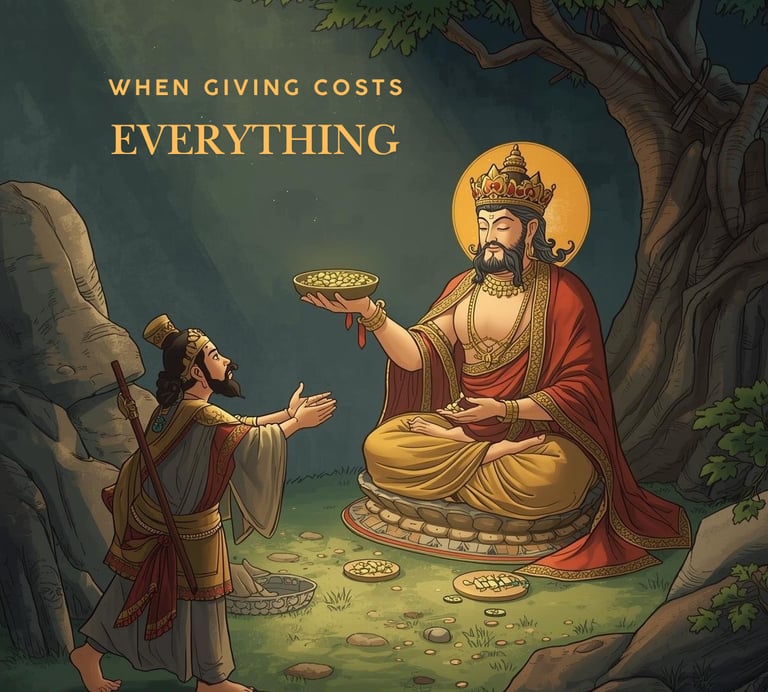
In another of the Jataka tales, the Bodhisattva is born as the King of the Shibis, a ruler blessed with immense wealth, power, and prosperity. Yet his greatest joy does not lie in command or conquest, but in giving. He establishes vast alms halls, generously filled with food, grain, clothing, shelter, perfumes, ornaments, gold, and silver—freely offered to anyone in need. Charity is not an obligation for him; it is his delight.
One day, while walking through one of these halls, the king notices something that deeply unsettles him. There are few people asking for alms. Their needs seem satisfied, yet his longing to give remains unfulfilled. This stirs a deeper reflection within him: would his generosity hold firm if the request were not for wealth, but for something far more personal—his own body?
Shakra, the Lord of the Gods, hearing this resolve, decides to test the king’s sincerity. Disguised as an old, blind Brahman, he approaches the king and asks for one of his eyes. Without hesitation, and unmoved by the pleas of his ministers, the king offers not one but both eyes—placing compassion above comfort, duty above attachment.
Later, the blind king sits peacefully by a lotus pond, content in his gift. Shakra then appears in his divine form and restores the king’s sight, honouring the purity of his intention. Standing before his astonished subjects, the king speaks a simple truth: wealth has meaning only when it is used to serve others.
The story of the King of the Shibis teaches that true charity is not measured by abundance, but by willingness. When giving is complete and selfless, even loss becomes gain, and generosity becomes a path to awakening.