
Morning Muse 221 : Arjuna’s Arrows and Algebra
A single shloka from Bhāskarāchārya blends algebra, warfare, and spirituality, revealing Arjuna’s strategy through a mathematical puzzle of one hundred arrows. Beyond calculation, it reflects Sanātana wisdom—where outer victory mirrors inner discipline and knowledge is inseparable from values.
2/9/20261 min read
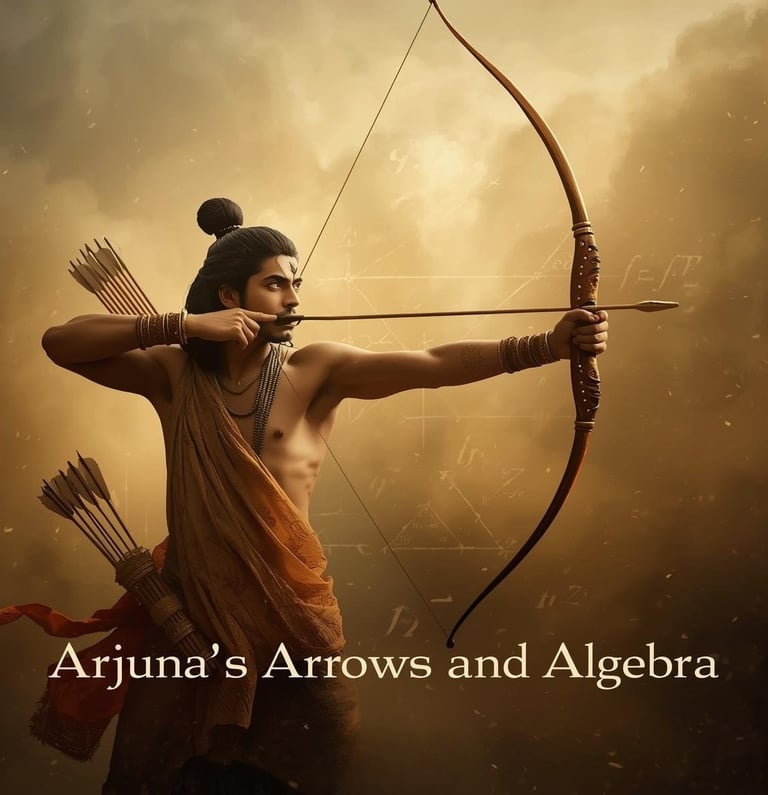
पार्थ: कर्णवधाय मार्गणगणं क्रुद्धो रणे संदधे तस्यार्धेन निवार्य तच्छरगणं मूलैश्चतुभिर्हयान् | शल्यं षड्भिरथेषुभिस्त्रिभिरपि च्छत्रं ध्वजं कार्मुकम् चिच्छेदास्य शिरः शरेण कति ते यानर्जुनः संदधे || ७६ ||
A single Sanskrit shloka from Bhāskarāchārya quietly dissolves the boundaries between mathematics, strategy, and spirituality. On the surface, it appears as an elegant algebraic puzzle from Leelavati, leading to the conclusion that Arjuna released exactly one hundred arrows in his final encounter with Karna—an equation solved centuries before modern mathematical systems evolved.
Yet beneath the arithmetic lies layered insight. Fifty arrows used to counter Karna’s assault reflect the scale of his formidable prowess. Forty arrows to subdue the horses reveal discipline and training. Six arrows to neutralize the charioteer suggest the removal of guidance and support. Three arrows dismantling the chariot expose vulnerability and helplessness. One final arrow completes the task.
Operationally, the sequence presents a timeless strategy: neutralize firepower, immobilize mobility, dismantle support, and only then strike decisively. Spiritually, the same pattern mirrors an inner journey—mastering desire, regulating the senses, steadying the mind, and ultimately moving toward liberation.
This is the quiet genius of Sanātana thought: vidyā fused with values, where a single verse teaches calculation, conduct, and consciousness. It reminds us that true knowledge is never one-dimensional—it is a meeting point of intellect, action, and inner awakening.