
Morning Muse 214 : The Snake Should Not Be Killed
True devotion is not found in symbols, clothing, or slogans, but in inner transformation. Faced with death, Gandhi chose stillness—not to save himself, but to save a cobra from being killed. Bhakti is living love and non-violence, even when fear and death are near.
2/2/20261 min read
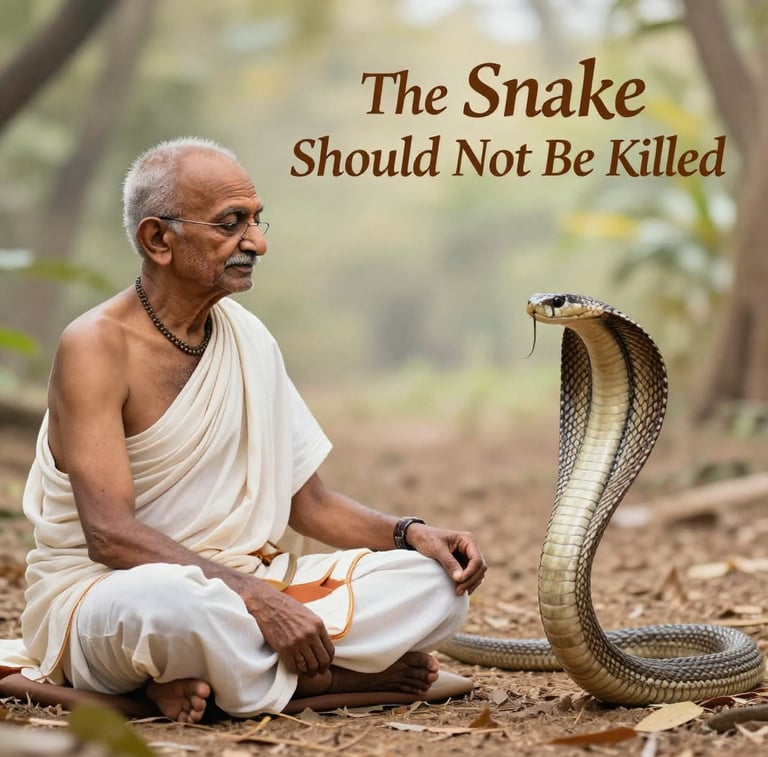
This land has given birth to many saints. One among them, not very long ago, was Mahatma Gandhi—a life shaped by love, compassion, and selfless service.
It is easy to call oneself his devotee.
Wear khādī.
Put on a white cap.
Display the symbols.
But devotion is not decoration.
It is transformation.
One winter morning, Gandhi sat quietly in his ashram, a folded blanket resting on his shoulders. Friends were seated nearby. Suddenly, one of them noticed a cobra crawling onto his back. Fear arose—but discipline held.
“Bāpu,” he whispered, “do not move. A cobra is on your back.”
Gandhi did not move.
Not even slightly.
The cobra slid into a fold of the blanket. The others rushed forward, pulled the blanket away, and the danger passed.
Later, someone asked him,
“Death was so close. What was going on in your mind?”
Gandhi replied with honesty:
“At first, there was a chill—a fear of death. That is natural.”
Then came wisdom.
“I realized I am not yet perfect. Fear still exists in me. If fear makes me move even a little, the snake will not understand. It will think I am attacking and will bite to protect itself. And if it bites me, the people here will kill the snake.
The snake will be killed.
The snake should not be killed.”
So he remained still—not to save himself, but to save the snake.
At the very doorstep of death, love and compassion outweighed self-preservation.
This is devotion.
Not slogans.
Not symbols.
But the quiet flowering of compassion, even for a creature that can kill you.
If those who call themselves devotees develop even a fraction of this love, their devotion has meaning. Otherwise, it is hollow—noise without understanding.
Bhakti is not what we wear.
Bhakti is what we become.