Morning Muse 197 : Practice Dying
All spiritual wisdom points toward one truth: learn to let go. To “practice dying” is to die to ego, fear, and illusion so that what is real may emerge. What is real cannot be lost; what can be lost was never ours. By surrendering to life as it is and remembering death without fear, we awaken to the present moment—where freedom, love, and authentic living begin.
1/15/20262 min read
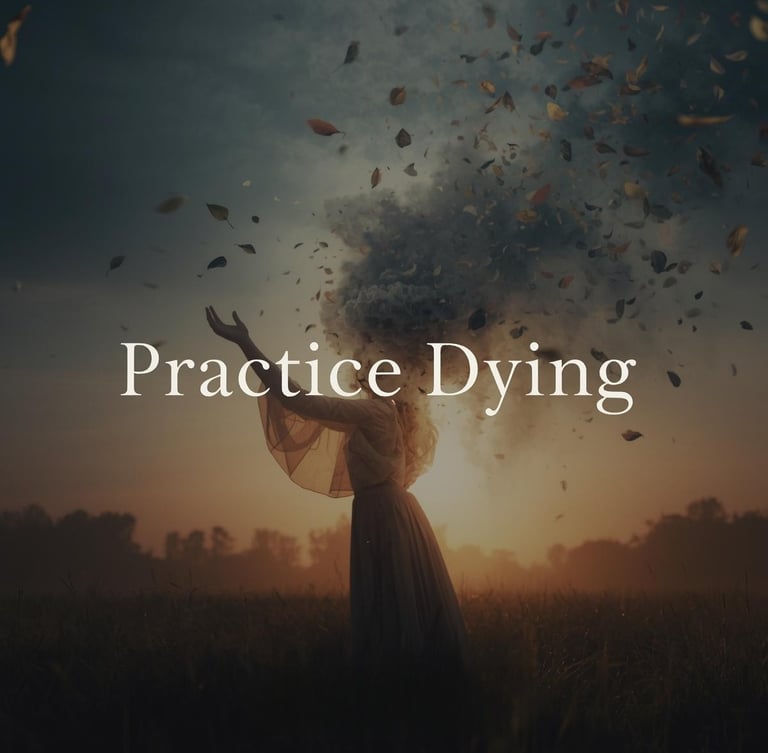
At the very end of his life, when Plato was asked to sum up his entire philosophy, he offered just two words: Practice dying. In that simple phrase, oceans of wisdom are contained. It is always astonishing how the deepest truths can be distilled into the fewest words. A Course in Miracles does this when it says, “Nothing real can be threatened, nothing unreal exists.” Osho, when asked about Zen, replied simply, “Let go.” On Tantra, he said, “Accept and surrender to what is.” Different traditions, different languages—yet the same essence.
Again and again, the sages remind us that true religion is not about learning how to live better on the surface, but about learning how to die inwardly. To die to the false. To die to what we are not. What is real—Life, Love, God, Nature, Dharma, Tao—cannot be lost. What can be lost was never truly ours. When this truth is discovered and lived, surrender becomes natural. We begin to say, “Thy will be done,” not as resignation, but as trust.
As surrender deepens, the unreal slowly dissolves. We stop clinging, stop resisting, and begin to flow with a deeper intelligence. Destiny is no longer forced—it unfolds. Like a seed that must die to become a tree, or a caterpillar that must dissolve to emerge as a butterfly, transformation requires a kind of death. As Rumi so beautifully asked, “When have I ever become less by dying?”
To practice dying is to practice trust—to move from a clenched fist to an open hand. Many who have touched this space find healing, even at the brink of physical death. Perhaps Plato was asking: why wait until the end? Why not let go now and be transformed while alive? This dying can be practiced moment to moment—dying to the past, dying to the known, dying to false identities, and surrendering into the mystery of the unknown. This is what it means to let go and let God.
There is another side to this practice. Stephen Levine once asked, “If you had a year to live, who would you call, what would you say—and why are you waiting?” That year could be a month, a week, a day, or even an hour. The only certainty is death. When this truth is held without fear, it does not depress us—it awakens us. It brings us fully into the present moment. It invites us to live passionately, love deeply, laugh freely, share openly, and give ourselves completely.
As Seneca said, “Throughout life one must learn how to live—and what will amaze you even more, throughout life one must learn how to die.” Leonardo da Vinci echoed the same truth: “While I thought I was learning how to live, I was really learning how to die.”
To practice dying is not to diminish life—it is to finally, truly live.