
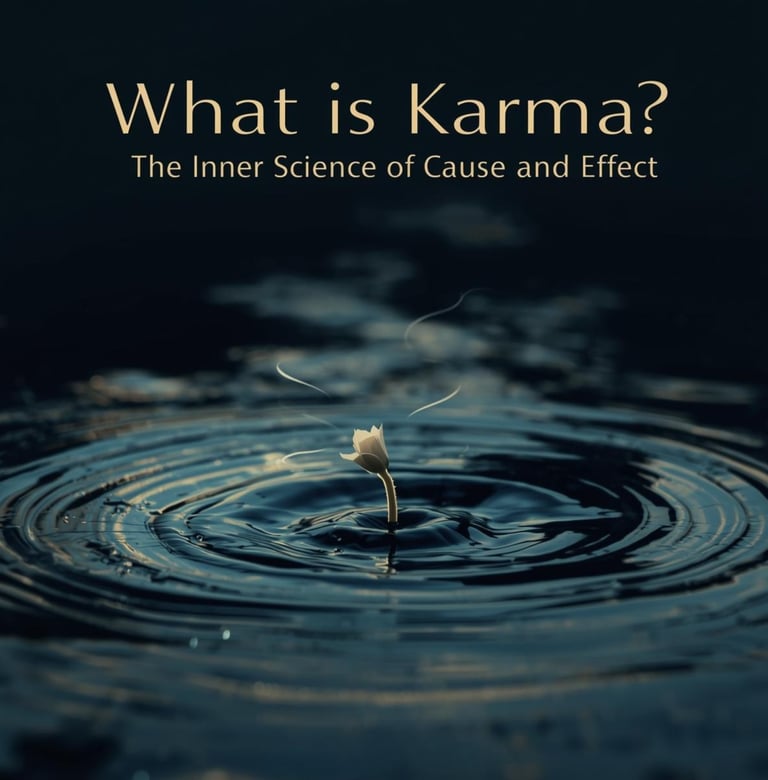
Morning Muse 141 : What Is Karma? The Inner Science of Cause and Effect
Karma begins long before an action is visible. The moment a feeling, desire, or intention arises, Sukshma Karma—subtle action—has already begun. When that intention takes physical form, it becomes Sthula Karma—gross action. While Karma is inevitable, bondage is not. Liberation comes when actions are performed with awareness, spontaneity, and detachment, free from ego and expectation.
11/20/20252 min read
There are billions of living beings in this universe, and within each of them rise countless feelings—love, desire, anger, compassion, joy. Every feeling generates an inner movement, an impulse that propels us toward action.
That impulse is Karma.
Karma is the principle of cause and effect present in every thought, word, and deed. The action that follows is Karma as well.
Karma functions on two levels: the subtle and the gross.
When a thought or desire arises within you—for example, the wish to build a home—that very impulse is Sukshma Karma, the subtle action. In that instant, creation has already begun. The idea has taken birth in the field of your consciousness.
When that inner desire slowly takes form—when you gather materials, plan, and eventually build the house—it becomes Sthula Karma, the gross or physical action.
Thus, Karma begins in the unseen and then flows into the visible, completing its journey from the inner world to the outer.
Every action leaves an impression on the mind. Some impressions fade quickly; others sink deep, becoming part of your emotional and mental patterns. These deeper impressions become the Karma you continue to carry.
But not all actions leave a trace.
Some actions pass through you effortlessly, leaving no residue behind. Why?
Because they were done with detachment, free from ego, fear, or expectation. This is what the Bhagavad Gita teaches when it says,
“Act without attachment.”
Do your duties, fulfill your responsibilities, but do not hold onto the results or the identity of being the doer.
Attachment binds; awareness frees.
There is yet another form of action—spontaneous action, arising from your true nature. Imagine a child falling; you instinctively rush to help. That is not planned or calculated—it flows naturally from compassion. Such actions do not create Karma because they are pure, selfless, and free from the sense of “I am doing this.”
Nature mirrors this purity.
A bird building a nest or a lion hunting is not accumulating Karma. They act in harmony with their essence. In this naturalness, there is no bondage—only flow.
Ultimately, everything in life is Karma—your thoughts, your speech, your actions, even your silence. But what binds you is not action itself; it is attachment, expectation, and identification.
When you act with clarity, compassion, and detachment, your Karma becomes light, effortless, and liberating.
So do not try to escape Karma—you cannot.
Life is movement; existence itself is action.
Instead, act with awareness.
Let your actions arise from love rather than desire, from balance rather than compulsion.
Then every act becomes a prayer,
every moment a step toward freedom,
and every breath an expression of your true nature.